Places · Burlington, Ontario
Published
Burlington Canal Lift Bridge: What's Inside the Towers (Giant Wheels and Falcons)
The rooms on top of the Burlington Canal Lift Bridge towers hold the lifting machinery: motors, gearboxes, huge pulley wheels and the steel cables that tie the road deck to giant counterweights. Each tower has two 150-horsepower motors. Nobody works up there day to day; crews climb up for maintenance, and peregrine falcons have nested on the north tower since 2003.
Facts checked
In this story
The box everyone wonders about
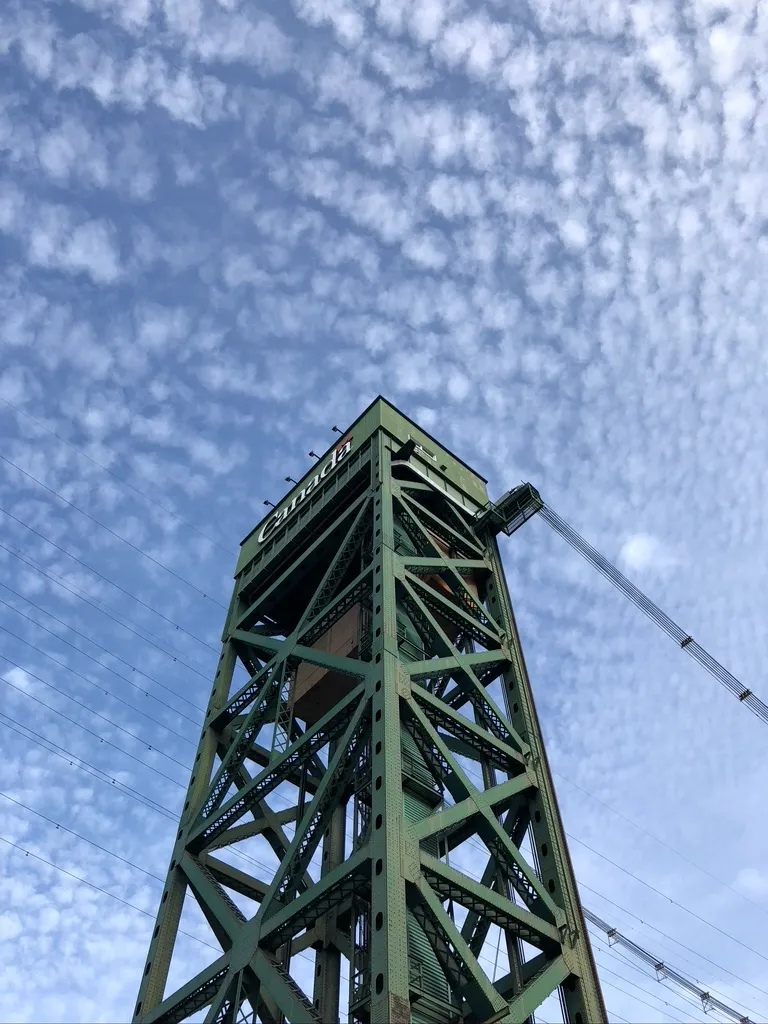
You have probably sat in your car staring at it. Two tall steel towers on Eastport Drive, and perched on top of each one, a boxy little building with windows. Windows! As if someone might be up there with a coffee, watching the lake.
So what is actually in there? The short answer is less mysterious and more impressive than you'd think: motors, giant grooved wheels, thick steel cables, and on one tower, a family of peregrine falcons who did not ask for neighbours.
Burlington's best guesses ranged from "Canada, obviously, it says so right on the side" to a strategic maple syrup reserve. The truth is the machine that lifts a road into the sky about 4,000 times a year.
Source: Public Services and Procurement Canada: Burlington Canal Lift Bridge
Source: Burlington residents discuss what is inside the lift bridge towers, August 2026
What it actually is
This is the Burlington Canal Lift Bridge, the federal bridge that carries Eastport Drive across the Burlington Canal, the narrow channel that lets ships get between Lake Ontario and Hamilton Harbour. It is owned and run by the Government of Canada through Public Services and Procurement Canada, which is why the city of Burlington can't help you when it's stuck up.
The towers, the government says, hold "the machinery, sheaves and wire ropes" that raise the span. Sheaves are basically huge pulley wheels. Wire ropes run over them, with the road deck hanging on one side and a massive counterweight on the other. When the deck goes up, the counterweights come down.
Burlington Canal Lift Bridge
Eastport Drive at the Burlington Canal, Burlington, ON
The towers hold the machinery; the north tower also hosts a peregrine falcon nest box.
Source: Public Services and Procurement Canada: Burlington Canal Lift Bridge
Source: Public Services and Procurement Canada: Burlington Canal Lift Bridge
Source: Local News: How things work, the Burlington Canal Lift Bridge (September 29, 2021)
What's inside the machine room
Each tower has a 150-horsepower drive motor and a second 150-horsepower synchronizing motor. That sounds like a lot until you learn what it is moving: a lift span weighing 1,996 tonnes, roughly the weight of 1,300 family cars, raised 33.5 metres, about the height of an 11-storey building.
The trick is balance. The two counterweights together weigh almost as much as the span itself, so the motors aren't really lifting the bridge. They are tipping a very large, very patient seesaw. Gearboxes do the rest, trading speed for brute force.
The two towers also have to move in perfect step. Cables strung between the tops of the towers carry power and signals between the motors so the span stays level all the way up. If one end rose faster than the other, the structure could jam and cause serious damage. Nobody wants a 116-metre bridge stuck at a jaunty angle.
People who have done repair work up there describe it plainly: giant gears, shafts and cable drums. One worker who fixed the bridge in 2012 summed it up as gears and shafts. Another said it's just the machinery for the lift. Less James Bond lair, more the world's biggest garage door opener.
| The bridge by the numbers | Figure |
|---|---|
| Opened | 1962 |
| Lift span length | 116 metres |
| Lift span weight | 1,996 tonnes |
| How high it lifts | 33.5 metres |
| Clearance for ships at full lift | About 36.5 metres |
| Motors per tower | One 150 hp drive motor plus one 150 hp synchronizing motor |
| Lifts per year | About 4,000 |
| Vessels per year | About 6,500, including more than 1,000 cargo ships |
Source: Public Services and Procurement Canada: Burlington Canal Lift Bridge
Source: Local News: How things work, the Burlington Canal Lift Bridge (September 29, 2021)
So how do workers get up there?
On foot, mostly. Nobody rides a lunch-pail commute to the top every morning to sit beside a big lever. People who have worked on the bridge say the room up top is only visited for maintenance and repairs, and that the bridge is operated from a control room much closer to the road.
Look closely next time you walk across and you can spot the stairs. Residents who know the bridge point out a staircase running up one corner of each tower, right below the small white box on the roof. Government planning documents for tower work talk about crews on "the tower roof and outdoor platforms," which tells you some jobs happen outside, high above the canal, in the wind. Respect.
And those windows? The likeliest reason is the boring one: daylight is cheap, and a mechanical room you can see into is easier to work in. Sorry to everyone hoping for a lighthouse keeper.
Source: Burlington residents discuss what is inside the lift bridge towers, August 2026
The falcons who live upstairs
Here is the part almost nobody guessed. Peregrine falcons, the fastest animals on Earth in a dive, have nested on the north tower since at least 2003. They started on a south-facing ledge. In 2007 a nest box was installed beside a south-facing window of the north tower, and falcons hatched chicks in it in the years that followed. A 2021 management plan prepared for the federal government says the nest should be treated as active every year.
That has real consequences for the people who maintain the bridge. Peregrines are listed as a species of special concern in Canada and Ontario, and the plan tells crews working on the tower roof to wear heavy jackets, hardhats and neck protection during nesting season, with someone watching the birds and warning workers if they get aggressive. It even plans for first aid if a worker is attacked.
So yes, there is someone living in the box on top of the bridge. They just have feathers and an attitude.
Six bridges, one canal
The canal opened in 1826, and people have been trying to get across it ever since. The current lift bridge is the latest of several. Earlier crossings included a swing bridge from 1830 that a schooner damaged, a railway swing bridge, an electric swing bridge in 1901 and a bascule bridge in the early 1920s. Today's bridge opened in 1962 and originally carried railway tracks as well as cars. The tracks came out in 1982, when the road widened to four lanes.
It recently had a big makeover. A $32.5 million project replaced the lift span deck and fixed up the approach spans, finishing in fall 2024. The bridge was closed to everyone from January to March 2024 while the work was done, and the west sidewalk was widened to 1.5 metres so wheelchairs fit.
Source: Public Services and Procurement Canada: Burlington Canal Lift Bridge
Source: Public Services and Procurement Canada: Burlington Canal Lift Bridge deck replacement project
Why it always goes up at the worst time
It isn't personal, even if it feels that way when you are late. Under federal navigation law, ships can't be held up during the shipping season, so cars wait. A big freighter needs more than 1.5 kilometres to stop or turn, so the bridge has to go up well before the ship arrives. That is why you can sit at the gate staring at empty water.
Pleasure boats get lifts at the top and bottom of each hour, and those usually take 5 to 10 minutes. Cargo ships get lifts on demand, typically 30 to 60 minutes, and longer when it's busy. The bridge has even paused the famous Around the Bay road race more than once, according to runners who were there.
From early January to mid-March the bridge stays down, and that quiet season is when crews climb up into the towers to inspect and repair the machinery. Which means right now, as the shipping season winds down, the box on top is about to get some visitors. The falcons will be thrilled.
Source: Public Services and Procurement Canada: Burlington Canal Lift Bridge
Source: Burlington residents discuss what is inside the lift bridge towers, August 2026
More place details
Source: Compare these places in Resources
Source: Burlington residents discuss what is inside the lift bridge towers, August 2026
Questions people ask
What is inside the boxes on top of the Burlington lift bridge towers?
Machinery that lifts the bridge: motors, gearboxes, large pulley wheels called sheaves, and the wire ropes that connect the road deck to its counterweights.
Source: Public Services and Procurement Canada: Burlington Canal Lift Bridge
Who runs the Burlington Canal Lift Bridge?
The Government of Canada, through Public Services and Procurement Canada. It is a federal bridge, not a City of Burlington one.
Source: Public Services and Procurement Canada: Burlington Canal Lift Bridge
Does someone sit in the top of the tower to raise the bridge?
No. People who have worked on the bridge say the operators work from a control room near road level, and the tower rooms are visited for maintenance and repairs.
Source: Burlington residents discuss what is inside the lift bridge towers, August 2026
How heavy is the lift span?
About 1,996 tonnes. Counterweights that weigh almost the same do most of the work, so the motors only need 150 horsepower per tower to drive it.
Source: Public Services and Procurement Canada: Burlington Canal Lift Bridge
How high does the bridge go?
The span rises 33.5 metres, giving ships about 36.5 metres of clearance at typical water levels.
Source: Public Services and Procurement Canada: Burlington Canal Lift Bridge
How often does the bridge lift?
About 4,000 times a year, for roughly 6,500 vessels, including more than 1,000 cargo ships.
Source: Public Services and Procurement Canada: Burlington Canal Lift Bridge
How long will I wait when the bridge is up?
Usually 5 to 10 minutes for pleasure boats and 30 to 60 minutes for cargo ships, and longer at busy times.
Source: Public Services and Procurement Canada: Burlington Canal Lift Bridge
When does the bridge stop lifting for the winter?
The navigation season runs from mid-March to late December. From early January to mid-March there are no lifts and crews do maintenance.
Source: Public Services and Procurement Canada: Burlington Canal Lift Bridge
Are there really falcons living on the bridge?
Yes. Peregrine falcons have nested on the north tower since at least 2003, and a nest box was installed by a north tower window in 2007.
How do I find out about bridge closures?
Public Services and Procurement Canada posts media advisories on Canada.ca and on its X account, @PSPC_SPAC. Boaters listen on marine radio channel 16.
Source: Public Services and Procurement Canada: Burlington Canal Lift Bridge
When was the current bridge built?
It opened in 1962. It originally carried rail tracks too, which were removed in 1982 when the road was widened to four lanes.
Source: Public Services and Procurement Canada: Burlington Canal Lift Bridge
Can I walk or bike across the lift bridge?
Yes. There is a sidewalk on the west side, widened to 1.5 metres in the 2024 rebuild, and the old rail alignment became a bike path.
Source: Public Services and Procurement Canada: Burlington Canal Lift Bridge deck replacement project
Something changed? Tell us about a correction.